Claude Code Plans vs. API Billing: Prices, Credits & Illustrative Spend Crossings
Compare current Claude subscription prices and included API credits with a clearly labelled enterprise spending example. A price crossing alone cannot prove that a subscription covers the same work.
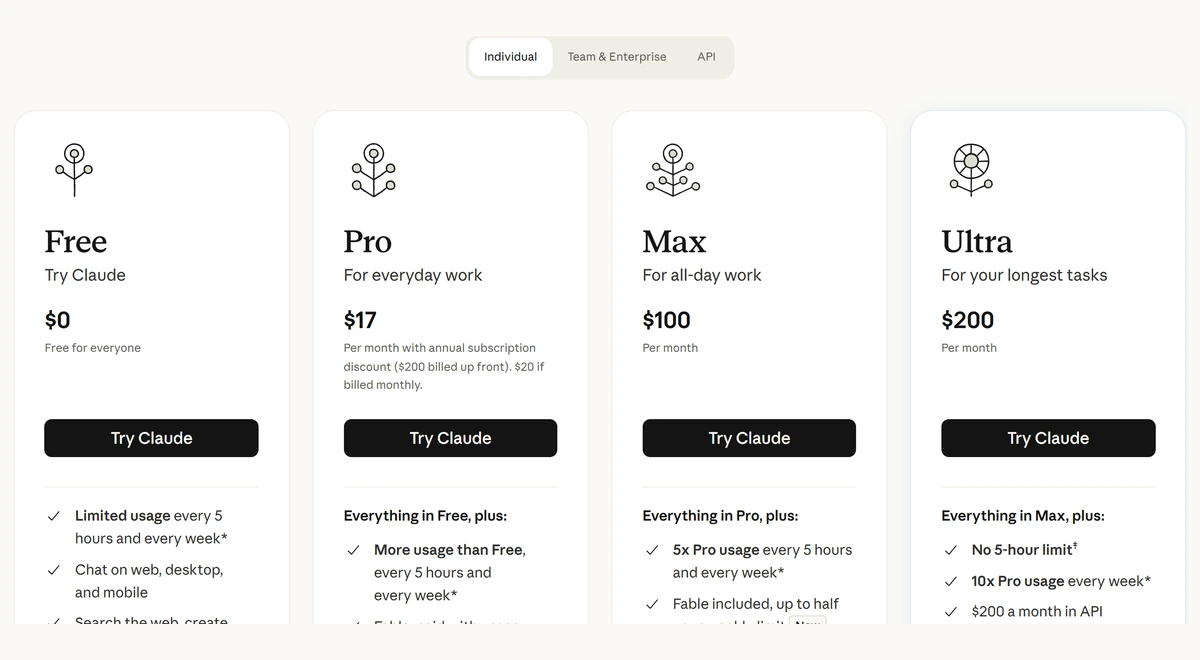
A monthly plan fee and an API token invoice buy different entitlements. The official Claude pricing page lists Pro at $20 monthly, Max at $100 monthly with $100 of monthly platform API credits, and Ultra at $200 monthly with $200 of monthly platform API credits. The annual Pro price is $200 paid upfront, often displayed as about $17 per month. Taxes and account-specific terms still apply.
Pro, Max and Ultra include Claude Code under plan usage limits. Max lists 5 times Pro usage per 5-hour window and per week. Ultra lists 10 times Pro weekly usage and no 5-hour limit for verified accounts. That does not make weekly usage unlimited. API credit availability, activation, eligible usage and expiration are governed by the account offer; confirm those conditions before valuing every included dollar as cash savings.
Use enterprise averages as examples, not personal forecasts
The Claude Code cost-management guide reports enterprise averages of about $13 per active developer day and $150–$250 per developer month, with costs below $30 per active day for 90% of users. The guide also says costs vary widely and recommends measuring a pilot workload. Those figures do not imply that every solo developer spends $13 on each day they open the app.
Dividing $20, $100 and $200 by $13 gives 1.54, 7.69 and 15.38 active days. These are arithmetic price crossings under a fixed $13/day assumption, not proven subscription break-even points. A plan can reach its quota before completing that amount of work. API automation and interactive plan usage may also differ in features, limits and supported authentication.
Separate plan fees, eligible API credits and extra usage
function monthlyOutOfPocket({planFee, apiSpend, eligibleCredits = 0,
                             extraPlanUsage = 0}) {
  return planFee + Math.max(0, apiSpend - eligibleCredits) + extraPlanUsage;
}
// Assume all credits below are eligible and used before expiration:
monthlyOutOfPocket({planFee: 100, apiSpend: 80, eligibleCredits: 100}); // $100
monthlyOutOfPocket({planFee: 100, apiSpend: 150, eligibleCredits: 100}); // $150
// These examples do not assign a cash value to interactive plan access,
// promise unlimited usage, or include taxes.
Compare the work you need and the entitlement you actually have
Read the entitlement column separately from the price-crossing column. The former describes listed plan features; the latter is only the stated fee divided by an assumed daily API spend. Completing the same task under actual plan limits is a separate question.
| Billing option | Monthly fee | Included usage / credits | Crossing if API spend were always $13 per active day |
|---|---|---|---|
| Pro | $20 ($200 upfront annually) | Plan quota; no listed monthly platform API-credit allowance | 1.54 days; does not establish equivalent quota |
| Max | $100 | 5x Pro quota; listed $100 monthly API credits, subject to terms | 7.69 days; count only eligible credits actually used |
| Ultra | $200 | 10x Pro weekly; no 5-hour limit for verified accounts; listed $200 API credits | 15.38 days; weekly limits still apply |
| API pay as you go | Metered token/tool charges | API rate limits; cache, output and tools affect spend | Use your actual measured workload, not the average |
Headless execution is a CLI mode, not a synonym for API-key billing. For unattended jobs, agents and CI systems, check the Claude Code overview and the authentication documentation for the selected workflow. Do not assume that buying Pro grants a general-purpose API quota, or that every non-interactive command must use an API key.
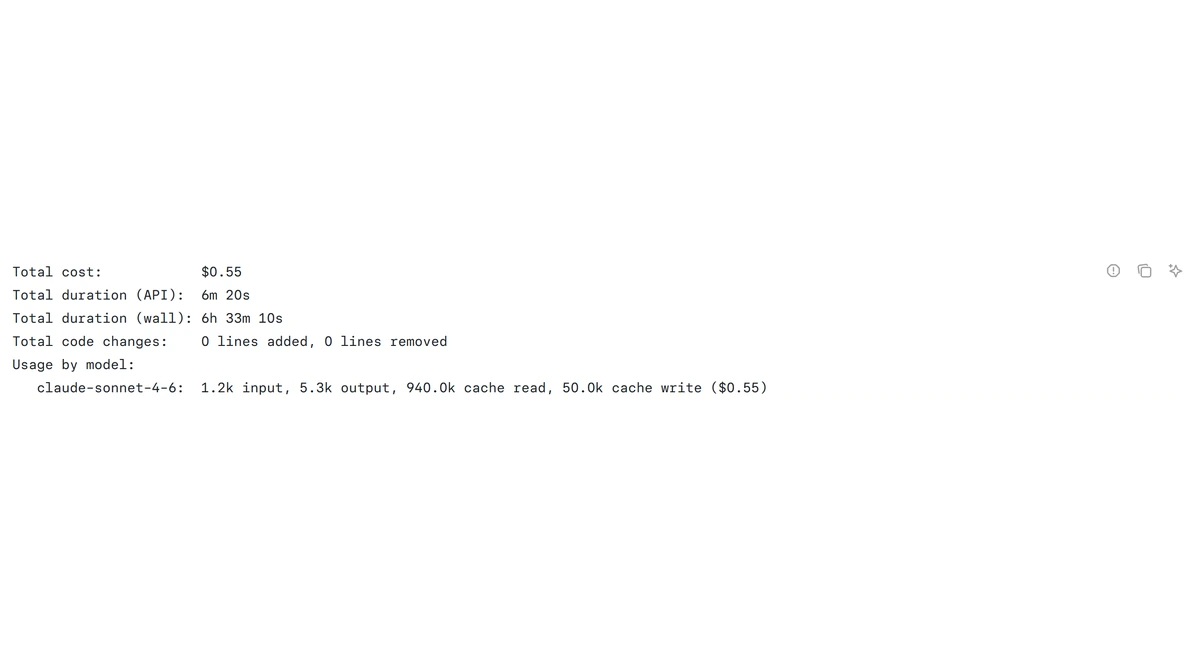
Use /usage to inspect actual token usage and plan quota bars, and compare several representative sessions before estimating a month. The calculator on this site now reports token costs without mapping arbitrary $80/$180 thresholds to a plan recommendation. It cannot infer your remaining weekly quota, organizational pricing, cloud contract or credit eligibility.
A good comparison measures the same work under each supported route: model, input and output tokens, cache writes and reads, tools, latency requirements and concurrency. Include the subscription fee even when credits offset an API bill. Unused or ineligible credits do not reduce spending, and time saved should be valued separately from vendor charges.
Rate tables are a November 9, 2026 documentation snapshot with announced schedule changes shown where available. Calculators use stated assumptions and are estimates, not invoices or measured hardware benchmarks. Check actual usage categories, account terms, cache behaviour, runtime allocations and cloud endpoint rates for a production decision.
Primary Sources & Official Vendor Documentation
- Anthropic · Official Claude Individual, Team & API Plan Pricing (Pro, Max, Ultra)
- Claude Code Docs · Manage Costs Effectively (Enterprise Daily & Monthly Spend Benchmarks)
- Claude Code Docs · Overview of Terminal & IDE Agentic Coding Workflows
- Anthropic Claude Platform Docs · Models & Prompt Caching Pricing Reference