LLM API Token Pricing, Prompt Caching & Batch Discount Formulas (Claude 5.5 vs. Gemini 4 Argon)
A side-by-side breakdown of per-million token rates, 5-minute and 1-hour prompt caching multipliers, 50% asynchronous batch discounts, and tokenizer overhead across Claude Fable 5.1, Opus 5.5, Sonnet 5.5, Haiku 5.5, and Google Gemini 4 Argon / 3.8 Flash.
A useful API budget separates ordinary input, cache-creation input, cache reads and generated output. Output estimates must include billed thinking tokens. We checked the Anthropic pricing documentation and Gemini Developer API pricing schedule on November 9, 2026. The calculator models token and selected storage costs; paid search and other tools, tax, account credits and negotiated cloud rates need their own line items. The calculator cache percentage is cached-read input tokens divided by total input tokens, not the percentage of requests that hit a cache.
Claude Sonnet 5.5 is $2/MTok input and $10/MTok output; Opus 5.5 is $4/$20; Fable 5.1 is $10/$50. Haiku 5.5 has two per-request prompt-length tiers: $0.10/$0.50 for prompts up to 100,000 tokens and $0.50/$2.50 above that threshold. The higher tier applies to the entire qualifying request, including cache reads and writes. A monthly total of 100,000 tokens is not the threshold.
Cache creation, cache reads and the real break-even calculation
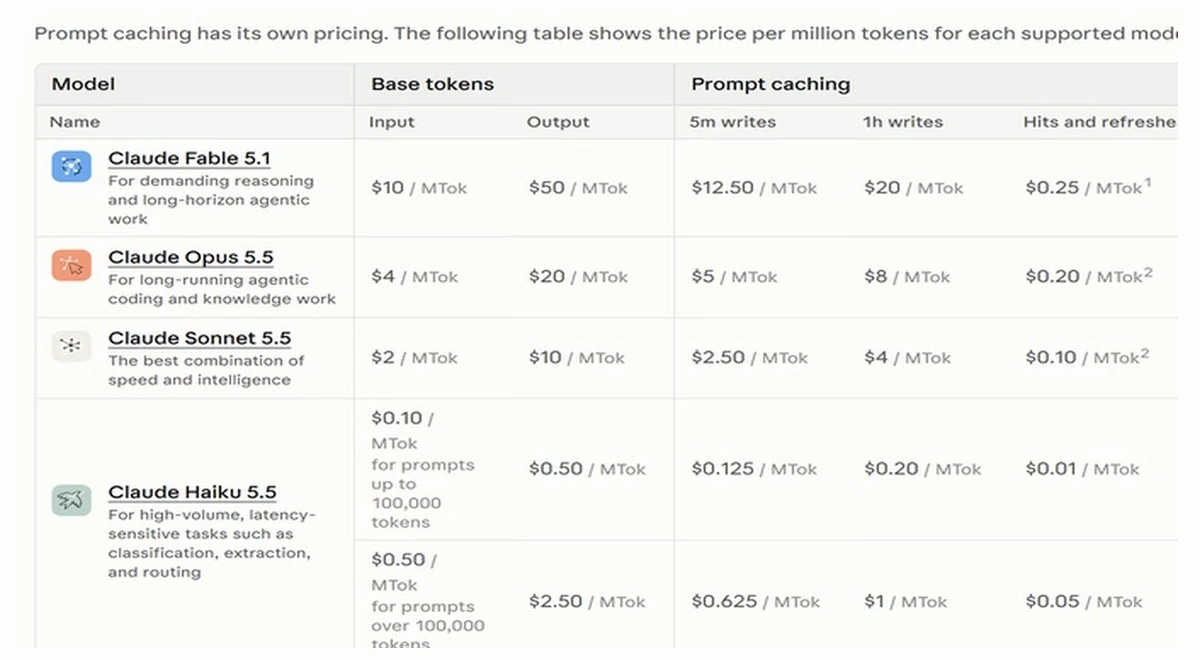
The prompt caching guide prices 5-minute cache creation at 1.25 times base input and 1-hour creation at 2 times base input. Cache reads on Sonnet 5.5 and Opus 5.5 cost 0.05 times base input; Fable 5.1 reads cost 0.025 times base input. Haiku 5.5 reads cost 0.10 times base input. A read is not a cache creation: the calculator lets you specify whether input misses are ordinary input, 5-minute writes or 1-hour writes. If your workload mixes these categories, use measured token-category totals in the formula below.
For a Sonnet 5.5 prefix, one 5-minute write plus one reuse costs 1.25 + 0.05 = 1.30 times one uncached call, versus 2.00 for two uncached calls. Across ten total calls—one write and nine reads—the cost is 1.25 + 9 × 0.05 = 1.70, versus 10.00 without caching: an 83% saving on that repeated input prefix. A 1-hour write first becomes cheaper on the third total call: 2.00 + 2 × 0.05 = 2.10 versus 3.00. These examples exclude unrelated input, output and tools.
Monthly token cost with separate input categories (Sonnet 5.5 example)
function tokenCostUSD({
  ordinaryInputMTok = 0, write5mMTok = 0, write1hMTok = 0,
  readMTok = 0, outputMTok = 0, batch = false,
  regionalScenario = false
}) {
  const tokens = ordinaryInputMTok * 2 + write5mMTok * 2.5
    + write1hMTok * 4 + readMTok * 0.10 + outputMTok * 10;
  // Supported batch discounts include cache writes and reads.
  return tokens * (batch ? 0.5 : 1) * (regionalScenario ? 1.1 : 1);
}
// 200 MTok input: 10 ordinary + 190 reads; 1 MTok output.
tokenCostUSD({ordinaryInputMTok: 10, readMTok: 190,
              outputMTok: 1, batch: true}); // $24.50
// If those 10 MTok are instead 5-minute writes: $27.00.
// Do not add cache storage, tools or tax to the token subtotal twice.
Batch discounts, Gemini schedules and endpoint scope
The Message Batches API supports a 50% discount on input and output, and that discount stacks with supported prompt-cache write and read prices. Batch cache hits are best effort, not guaranteed. The calculator uses the hit ratio you supply; production budgets should use observed usage categories. For the same 200M-input, 95%-read, 1M-output example, ordinary misses produce $24.50 with batching; treating all misses as 5-minute writes instead produces $27.00.
| Model / request tier | Input / output | Cache creation 5m / 1h | Cache read | Batch input / output |
|---|---|---|---|---|
| Claude Fable 5.1 | $10 / $50 | $12.50 / $20 | $0.25 | $5 / $25 |
| Claude Opus 5.5 | $4 / $20 | $5 / $8 | $0.20 | $2 / $10 |
| Claude Sonnet 5.5 | $2 / $10 | $2.50 / $4 | $0.10 | $1 / $5 |
| Haiku 5.5, prompt ≤100K | $0.10 / $0.50 | $0.125 / $0.20 | $0.01 | $0.05 / $0.25 |
| Haiku 5.5, prompt >100K | $0.50 / $2.50 | $0.625 / $1 | $0.05 | $0.25 / $1.25 |
| Gemini 4 Argon, through Nov 30 | $2 / $10 | Implicit caching only | $0.10; batch $0.05 | $1 / $5 |
| Gemini 3.8 Flash, through Dec 31 | $0.75 / $3.75 | Explicit storage: $0.50/MTok-hour | $0.075; batch $0.0375 | $0.375 / $1.875 |
The Gemini Developer API pricing schedule announces a December 1, 2026 increase for Gemini 4 Argon to $4/$20 input/output and $0.20 cache reads; batch rates become $2/$10 with $0.10 reads. Gemini 3.8 Flash doubles its listed standard input/output/read prices on January 1, 2027, and explicit-cache storage moves from $0.50 to $1.00 per MTok-hour. Storage charges do not receive the inference batch discount. The pricing-date field applies these published schedules; it does not fetch unannounced future price changes.
Claude partner-operated Bedrock regional and Google-managed multi-region endpoints have a documented 10% premium over their global endpoints for eligible model generations. This is not a generic Gemini Developer API surcharge. The calculator treats it as an optional Claude list-price scenario; verify your actual service, endpoint and cloud contract. Gemini selections disable that switch.
Anthropic also documents roughly 30% more tokens for identical text with newer tokenizers, with the actual change depending on the workload. If a particular workload really grows by exactly 30%, moving from $3/MTok to $2/MTok input gives 1.30 × $2 = $2.60, or 13.3% lower input cost. That is an example, not a guaranteed saving per character. Cache TTL expiry, minimum cacheable prefix size and output token count can outweigh that comparison.
Rate tables are a November 9, 2026 documentation snapshot with announced schedule changes shown where available. Calculators use stated assumptions and are estimates, not invoices or measured hardware benchmarks. Check actual usage categories, account terms, cache behaviour, runtime allocations and cloud endpoint rates for a production decision.
Primary Sources & Official Vendor Documentation
- Anthropic Claude Platform Docs · Models & Official API Pricing Overview
- Anthropic Claude Platform Docs · Prompt Caching Multipliers & Architecture
- Anthropic Claude Platform Docs · Message Batches API (50% Asynchronous Cost Reduction)
- Google AI Studio · Gemini Developer API Pricing (Gemini 4 Argon & Gemini 3.8 Flash)